“Wait, what’s diabetes again?”: Perspective from a 9-year-old

“Wait, what’s diabetes again?” my 9-year-old cousin (we’ll call him Daniel), inquired, eyes widening.

The wind suddenly knocked out of me, I deflated like a balloon in my chair at the dinner table.

He doesn’t know?

Thank God he doesn’t know!

How can my response enlighten him while maintaining his innocence, leaving him just the way he is- unscathed by diabetes?

How do I explain a disease that rocked my world by the time I was his age, while simultaneously praying that he never truly has to understand?

My grandmother had been describing a friend who was exhibiting the telltale symptoms of diabetes onset- extreme thirst and sudden weight loss.  Despite being familiar with the disease, my grandmother had not jumped to the diabetes conclusion.  Her friend was older and type 1 diabetes was not on the radar.  Thankfully, her friend was diagnosed and received proper treatment.  One drop of blood was tested in time.

As we lamented the lack of awareness of the warning signs of diabetes, I noticed Daniel’s focus shifting to us.  He fidgeted in his chair, the wheels spinning in his head.

Do I drink a lot?  Do I pee a lot?, he wondered.

Then: “Wait, what’s diabetes again?”

I took a deep breath and blinked back tears, buying some time to regain my composure.

“See this roll on my plate?  When you eat this roll, something called insulin helps you to process the food and receive energy from it.  I have diabetes.  So my body does not make insulin to cover the food that I eat.  I take shots of insulin to stay healthy,” I replied, except there were many more “umms” and much less eloquence in that moment.

Daniel looked directly at me and nodded.

“Oh, okay,” he said, satisfied with my explanation.

And with that he took off, dancing around the living room with the other cousins, back to more pleasant daydreams of race cars and Legos in place of insulin syringes and frequent urination.

Back to the way it should be.

We need a cure.


UHC/MDT Debacle Through the Lens of a Bruised Insulin Injector

If I were to fit the stereotype of a self-absorbed Millennial, I shouldn’t give an albino squirrel’s @$$ that UnitedHealthcare will solely cover Medtronic insulin pumps in the near future.

^ Albino squirrel spotted in Washington, DC.  He told me that a laboratory cured him of diabetes!


Well, albino squirrels are real, and so is this Millennial.

I do care.

My insurance provider is not UnitedHealthcare.  I walked away from my Medtronic insulin pump over a year ago.  Currently, I manage my type 1 diabetes using Lantus and Humalog insulin pens, the traditionalist method of being certain that insulin is getting into my body.  My stomach bears the bruises to prove it.

Disappointment still lingers when I think about the divorce from my Medtronic insulin pump.  I identified an infusion set defect, and spiked high ketones with every site change.  I pleaded with Medtronic to help, to find an alternative solution, to listen and to trust me.  For awhile, they did.  But then the problems kept happening, and I kept emailing, and they finally chose to stop responding.

They walked away.  If only I could abandon my type 1 diabetes so easily…

I have been vocal about my insulin pump tribulations, but I have always given Medtronic the benefit of the doubt at the end of the day.  My situation was a rarity; most people have good hearts; the manager who did not respond to my emails was told to do so by higher-ups who feared a lawsuit; she went home at night and felt a twinge of guilt, wondering if I was still sick with ketones from my failed pump sites.

At least that’s how I try to imagine it.

When I first saw the headlines about UHC and MDT teaming up, I was frustrated but not surprised.  Finally, people were seeing the light.  Rather, the darkness.

Our healthcare system involves give and take, tug-of-war with patients’ quality of life and companies’ profits at stake.  Although the Affordable Care Act gave us coverage for pre-existing conditions, the ability to stay on our parents’ plans until age 26, and supposedly lower costs, the reality is that in order to receive, we also have to give.  To cut costs in one place, costs have to shift somewhere else.

Medtronic and UnitedHealthcare are not the only companies out there striving to make a profit in a newly-designed medical playing field.  Perhaps their business arrangement was intelligent for their own financial reasons.  Public relations-wise, not so much.  Only time will tell the true breadth of this so-called deal.

As we over-emphasize cost-cutting, we must be careful not to also snip choice and patient autonomy.  Reducing costs sounds great in the short-term, but we cannot disregard the long-term.  If patients’ health is compromised by inadequate access to resources, all the costs that insurance companies may have saved upfront will later be seen in hospital bills and subsequent treatment.

Under my current insurance plan, a preferred provider organization (PPO), I can go out-of-network if I so choose and if I have the capability to pay more for that care.  There are times where I believe wholeheartedly that an out-of-network provider is the absolute best shot at achieving better health.  That is my prerogative, and, understandably, my financial situation to figure out.  While the pricing may not be pleasant, what is most important to me is that I am able to access that care.  If high-quality care means sacrificing my own money for a vacation or a fancy new car, that is my choice.  If my financial situation changes later on, perhaps I will have to reassess and fall back to an in-network provider.  Yet such ability to choose should never be limited by the government or by insurance providers.

Collusion of insulin pump coverage is concerning not only for the diabetes community, but for healthcare at large.  Imagine the ramifications of collusion in multiple disease categories, of various insurers, corporations, and pharmaceutical companies.  Sure, big business is big business, but ethics should be ethics, too.

Notably, in “socialized healthcare” situations all over the globe, we must concede how much give-and-take is occurring.  Patients may have to wait months to be seen by a provider, and that provider may be mediocre.  Such is the sacrifice for limiting the free market.  On the flip side, we have gargantuan healthcare costs here in the U.S. because we roll the dice on access and affordability of treatment in the name of corporate greed.  If the grass is apparently always greener, well, it looks pretty yellow from my point of view, no matter how or where you slice healthcare financing.

Next weekend I will walk at my Commencement ceremony, having completed my Master of Science in Healthcare Administration and Management degree in December of 2015.  The UHC/MDT situation reminds me of a moment in our Public Health course.  As our Professor detailed how “money talks” in medicine, a longtime nurse in the class shook her head, visibly horrified.

“Is that really how this all works?  People don’t simply want to help others who are hurting?” she asked, bewildered.

She was like the little kid learning that Santa is not real, her innocence suddenly dissipating before our eyes.

The reality of healthcare is that money does talk.  Yet, like my classmate, we have to keep the hope alive in our hearts that some of us good eggs are in it for the long haul, for improving lives and fostering genuine human connection in the process.  Medtronic and UHC have called such goodhearted concepts into question, which is why we are now experiencing #AllOfTheFeelings.

Circling back to my personal, weird insulin pump scenario: The things that kept me afloat during such dire straits were my compassionate healthcare team, and the ability to choose.  When my Medtronic pump was no longer a good fit for me, some semblance of hope remained.  I could always sidestep over to a different insulin pump brand, for example.  Or, I could return to multiple daily injections, which I ultimately decided to do.  My doctors and nurses listened to me; they trusted my judgment as an informed, engaged patient; and they lifted me up on the days when it all seemed too heavy a cross to carry on my own.

Not one second of that ordeal was easy.  But we did it, somehow.

My advice to those overwhelmed by anxiety about access to health technology in light of the UHC/MDT deal is that you will survive somehow, too.  It may not be enjoyable.  It royally sucks that such a violation of your trust as a consumer has occurred, and that your freedom of choice has been stripped away.  It is morally reprehensible that this is happening under the guise of expanding innovation; limitation of choice, in fact, stifles creativity at all levels.  You have a right to be angry as hell.  Lean on each other liberally.  Remember that there are people overseas, or even in our own backyards, who do not have access to insulin.  Our voices must lift them up, too.

Hard times boil down to the good eggs and the bad, the people who answer emails filled with desperation and suffering, the companies which accept responsibility and troubleshoot the issues, the patients who never stop advocating no matter how sick they feel, and the medical teams which have their backs.

Healthcare is a complicated equation.  But we are on the right side.

We are the people who care.

Medtronic and UnitedHealthcare, do you care enough to join us?


The Cloak of Diabetes

Diabetes has a knack for eliciting the barter games, those if/then compromises we make with ourselves, with God, with anyone who will listen.  Parents wish to switch places with their diabetic children, to endure all of the needles in their places.  Authors like Gail Caldwell document the phenomenon: “It broke through my disbelief, my God bartering, my every other defense, and for this reason I both needed and hated to go there.”

When it comes to diabetes, I’m not sure I want another person to go there, either.

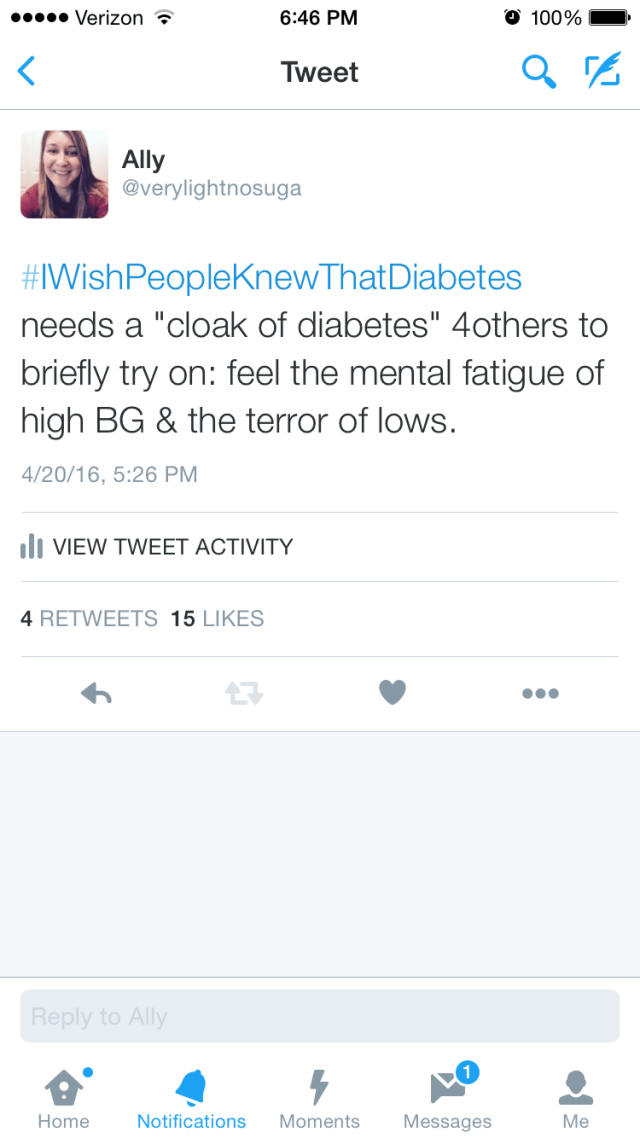
During #IWishPeopleKnewThatDiabetes day, organized by the lovely Kelly Kunik, I tweeted:

IMG_3443

Diabetes is not all misery and sorrow, but let’s be honest: It would be amazing to wake up each morning and not have to prick our fingers, perform Calculus to determine a breakfast dose of insulin, rein in the effects of that insulin if it is inadvertently too much or too little, push back against misinformed stereotypes of the disease, and think about this stuff frequently as we lead the rest of our busy lives.

Frankly, diabetes is not “fun” enough for me to want to pawn it off on anybody else in good conscience.  This is why #weneedacure for future generations.  It is also why I invented the cloak of diabetes which hangs in the hall closet of my mind.

The cloak of diabetes is a way to explain that I want empathy with no strings attached- no harm, no foul.  Empathy does not mean that my doctors or friends have to live 25 years of diabetes to know exactly what it feels like to me.  Ideally, empathy means that they “get it” without having “it.”  They do not need to have diabetes to understand how frustrating being awake all night checking blood sugars is; they can trust when I tell them that the level of exhaustion is off the charts when that happens.  They can realize that sometimes saying the right thing means saying nothing; sitting with me in those moments is enough.

Even if diabetes is mostly manageable in the midst of living a full life, there are still the bad days where it hurts like hell.  I do not want my family, friends, or doctors to hear the words “chronicity” or “no known cure” and to imagine that their diabetes sentences are lifelong.

Hence, the cloak of diabetes.  They could throw on the cloak and briefly experience the grumpiness associated with high blood sugar, or going to bed hungry but unable to eat.  The shakiness in their hands of a bad hypoglycemic episode would be an acute incident, resolving when the cloak of diabetes is returned to the coat check.  The anxiety of the “what ifs” would dissipate when their lab work came back normal.

They could “get it” regarding diabetes, without actually having “it.”  They could empathize while having a better picture of what diabetes physically and mentally feels like.

But then it would go away.  Diabetes is not something that I want them to know intimately.  A little bit is enough.  So, I go back to the God-bartering games.

If I have to have diabetes, please don’t let them have to have it, too.  Allow me to be accepting of their support. 

Can I hang up Your cloak?  The weather looks nice today.

Naked and Not-That-Afraid

Admit it. You clicked. But I pinky-promise Very Light, No Sugar is not about clickbait. Instead, let’s have a good time with this one.

The Discovery Channel hit a homerun with its series Naked and Afraid, which drops made-for-TV couples in the middle of nowhere and challenges them to survive together with few resources. Heavy emphasis on few resources. Because oh yeah, the individuals are naked while doing all of this, their not-so-PG-features blurred out with video editing and then broadcasted all over cable television.

I’d argue living with chronic illness presents similar trials. At diagnosis time, your entire world was rocked. You were thrown into unchartered waters with a leaky inflatable raft and asked to somehow make it all work. And you did. Some days are better than others, but even on the worst of days, you’re still floating.

Picture the tabula rasa of #doc Adam and Eve in the Garden of Endocrinology. They have no shame. They have not experienced the “diabetes police,” the misinformed stereotypes, the media onslaught. They are simply there, together. And naked. Except for those button-looking health technology thingamajigs attached to their skin.

Eve may have come from Adam’s rib, but the missing aspect of the story is that she came wielding prehistoric weapons of mass destruction: CGM inserters. Hence, Adam’s rib pain. From there, they took turns replacing insulin pump infusion sets for one another, the very first example of putting the “care” in healthcare. There were no deductibles or tense waiting rooms. This was solely Adam and Eve, charting the course together.

When they found the apple, they wondered how much to bolus for the carbs.

“This looks like a McIntosh. What do you think? 15 grams?” Diabetic Eve asked, squinting at the red and green hues.

“I don’t know. That’s kind of big. Won’t Endo yell at us if we don’t get this right?” Diabetic Adam fretted.

“Don’t be a wuss, bae,” Diabetic Eve retorted.

And so they each took a bite, tossing the apple back and forth. A few minutes later, the CGM beeped, its graph entering the yellow “high” territory just in time for the dreaded Endo appointment.

*****

As I previously wrote, I received my Dexcom supplies last week after fighting for far too long to obtain them from various avenues.

The new Dexcom transmitter has been great, from what the box still holding it tells me. After all of the drama in reordering the Dexcom, I would have bet money that I’d insert a sensor and begin the 2-hour warm-up within minutes of the package delivery.

But that did not happen. I do not exactly know why, but I have some educated guesses:

I got so burnt out by the process that I wanted nothing to do with health tech once the battle was won.

This is not for lack of being thankful; I am eternally appreciative of the positive impact of diabetes technology. Instead, this is about needing a break, to not think about something that consumed my thoughts for weeks as I awaited its arrival. Considering I use insulin pens instead of an insulin pump, my body is momentarily device-free. Now I’m working on such a literal and figurative diabetes reprieve for my psyche, too.

Perhaps the tech hiatus is also a “screw you” to our ridiculous, convoluted system. The healthcare loop-de-loop may have briefly stripped me of my dignity, but this tech vacation affords me some “control” again. I have the ability to make my own decisions about my body, mind, and soul.  This is the first step in putting my anger aside to do so.

Years ago, the conversation would have played out like this:

“You’re so stupid! How can you be so ungrateful? After going through all of that to get a new Dexcom, and spending all of that money, you’re just going to let it collect dust in the corner?!! Just so, so, stupid. So selfish.”

Many conversations with compassionate friends and healthcare providers later, I know now that the people who said those harsh things to me could never handle the constant nature of diabetes if they had to live it. I can. It is not always graceful, but I do it. I’m not stupid. Or ungrateful. Or selfish.

Tired? Yes. But every new morning is a “reset button.” This time I will not be pressing the button on a tech device; this reset button is an emotional one that cannot be objectively quantified. Its name is Freedom.

Diabetes is a catch-22, a continual give-and-take, a balancing act on a tightrope that is jostled every few minutes. Sometimes we have to weigh the risks and benefits, the pressing concerns and the long-term impacts. In doing that, I recently realized that my emotional needs trump the physical safety ones provided by Dexcom, in this immediate moment.

Although I miss Dexcom alarms alerting me to problems overnight, I have to trust my own intuition again. Strip it down, back to the basics, Diabetes 101. Simplify.

I set nighttime alarm clocks and hope that now is not my time to go via an unshakeable low blood sugar in my sleep. And if it is my time to go, well, that’s mostly in God’s hands, anyway. My gut tells me that a Dexcom break for a few weeks will do more good than bad, so I’m running with that idea. I am trusting in Him, and trusting in me.

When I am ready, I will definitively return to CGM. Without Dexcom, I find myself looking back at my apartment whenever I climb into my car, sensing that I left something behind, like I am reaching for a familiar hand that suddenly is not there. I miss slipping into Dexcom’s added diabetes security blanket like it is a favorite pair of boots, the perfect fit.

For now, though, I am going to enjoy the little things again: the long, hot showers; the consumption of McIntosh apples with old-fashioned carb-counting and blood sugar checking a few hours later; the silence of a room devoid of vibrating tech devices; what it feels like to be Ally in her own skin- skin that is entirely her own real estate right now.

Like Diabetic Adam and Eve, I am naked and trying my best to remain strong, and good.

I am naked and not-that-afraid.


Good Eggs Versus Goliath

???

I’m asking the same darn question. What in the actual Swear Word is going on?!

Let’s get the disclaimers out of the way upfront:

I am, undoubtedly, one of the lucky ones when it comes to health insurance. We can have the debate over whether or not Dexcom is a necessity or a privilege some other time. If I was stranded on an island, obviously insulin would be priority number one. But outside of being stranded on an island, Dexcom is a tool that keeps me safe. Because I value the high-quality product provided by the most innovative company on the market, I chose to fight for my supplies recently.   

Yes, I am a minnow in the healthcare pond. Society is filled with bigger fish who only see $$$, not the frustration of minnows who see ??? on their Dexcom screens. But does that mean that I have to lose hope in humanity? Nope. There will always be good eggs fighting against Goliath, and I want to give everyone that benefit of the doubt. When I lay my head down on the pillow at night, I want to know that despite whatever diabetes-related concerns I may harbor, I still tried. Hence, this blog post.

We all deserve better in healthcare. Step 1 is openly talking about it.

Long-story-that-has-been-rehashed-far-too-many-times-on-Twitter-short:

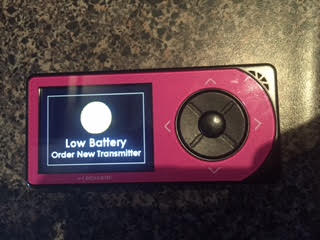
My Dexcom transmitter alerted me to its quick decline a few weeks ago. I immediately placed all of the appropriate phone calls to Dexcom and my third party supplier, Neighborhood Diabetes, as well as emailed my endo clinic. Unfortunately, we all go through these healthcare loop-de-loop headaches from time to time; I am well-aware that this problem occurs to others, too, and I am just as livid about their interruptions in quality of life as I am about my own. What was different for me this time around was how unnecessarily drawn out, draining, and dehumanizing this war with Goliath was.

low transmitter battery

How many steps does it take to receive a diabetes supply in 2016, you might ask?

  • 15 phone calls to third party suppliers, endocrinology clinics, and Dexcom customer service
  • 13 emails to various providers
  • 2 voicemails from third party supplier
  • Hitting “refresh” on the USPS tracking website a pathetic number of times
  • Gazillions of Twitter vent sessions
  • Countless hours of interrupted workdays during these phone calls/wait times
  • 1 box of Puffs Plus to dry your tears of frustration
  • 4 trips to your apartment’s leasing office mailroom
  • 2 awkward encounters with the mailman as you stalked his delivery route
  • 2 weeks of remembering what it was like to sleep pre-Dexcom

-Hint: I won’t take Dexcom for granted again, although I am in a tech- detox until this weekend because, frankly, I need a mini-vacation after this ordeal.

-Notably, all of this is for ONE supply out of thousands needed in our diabetes lifetimes!!!


There are also elements which we cannot objectify so easily:

  • Anger that our supposedly new and improved healthcare system remains SO disjointed
  • Extreme guilt that this is a first world, continuous glucose monitor problem when so many in our own backyards and overseas struggle to obtain the basics required to live with diabetes

-If being “angry that you are angry” is a thing, it was definitely my thing this week.

  • Which leads to more anger and self-doubt: Am I handling this well? Am I dramatic?

-Repeat that cyclical conversation in your brain a billion times over.

-Still feel guilty, as if YOU did something wrong here.

-Recognize that ^ is what abusers do to their victims; they twist the responsibility. Acknowledge that healthcare can be a big bully, and that no one deserves this.

-Realize that no, this situation is ludicrous. But yes, you are still blessed compared to others that you have what you do.

  • Demoralization that you have to beg and beg and beg to be heard. That you have to explain, on every call, why this product is important. That once again you are at the mercy of something beyond your control, and diabetes has a hand in that just like it did during that horrific low on your middle school field trip so many years ago.  Use incomplete sentences to express how off-putting this is.
  • Brokenhearted that this will likely happen many times over because #weneedacure that is realistically still far away.
  • Misunderstood: How can we possibly articulate how. much. time. we spend battling for supplies in order to survive?
  • What about how little time that leaves to actually live?


Understandably, Dexcom is going through some growing pains due to chart-topping progress recently. Their call center is overworked. I’ll admit all biases here: I like Dexcom a lot, and I cut them some slack here because I have faith that they will rein in this situation soon. All of that aside, though, waiting one or two hours to reach a representative is not anyone’s idea of a good time.

Dexcom did call me back and apologize, a feat that earns them more brownie points in my book. We live in a society that is quick to criticize and slow to forgive. Knowing this, Dexcom still took accountability for the things that went awry, which allows me to trust in their company character.

Then there was my supplier, Neighborhood Diabetes, which has historically answered phone calls at rapid-fire pace, winning my admiration. Initially, they performed in their usual customer-centric manner, getting the ball rolling on my new Dexcom order.

My endo clinic needed to dot some i’s and cross some t’s for insurance. But their email system is sporadically down, to the point where patients and providers alike cannot communicate effectively. A few phone calls later and I was reassured that their part of the deal had occurred.

So, I called Neighborhood Diabetes back, prompting my order to ship out before last weekend.

Cool, except that order never shipped out due to a “glitch,” which was discovered during my repeated “What the heck?!!!” phone calls. Transparency goes a long way, and I am happy that one of ND’s representatives was honest with me about the issue. Yet I couldn’t help but envision my islet cells doubling over in laughter as they recalled that time 25 years ago when they had a little “glitch,” too.

Two weeks after this fiasco began, even the mailman was happy when delivery day arrived. I could not help but be reminded of the good eggs in the world as I found his smiley face emoji note, and the subsequent Neighborhood Diabetes package in the box to the left, to the left. 🙂

mailman note

Neighborhood Diabetes box

As diabetics, we have to be on our A-game every day. Our lives depend on it. Our family and friends rely on it because they do not want to prematurely lose us. We are all human and we all mess up from time to time. But we do not get the luxury of inefficient or ineffective practices. We do not get to have “glitches” or one-hour hold times at the call centers of our own bodies whenever we want a break from diabetes.

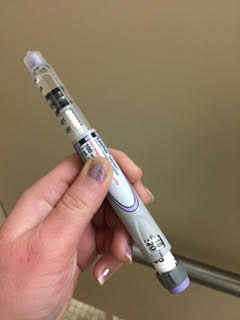
Lantus

There were many moments over the past few weeks where I longed to mimic Kristin Cavallari’s famous Laguna Beach line, “My car is dunzo!”, except I would have replaced “car” with “pancreas” or “emotional stability.” Honestly, this whole situation broke me more than a scary low blood sugar ever could. It made me question my strength in handling all of this, but I also discovered one very clear truth:

In healthcare, there are good eggs and there is the Goliath of the broken system. Although an egg’s hard exterior may crack under pressure, the goodness inside is what matters when all is said and done.  Be one of the good eggs.


Sleuthing

This week I exhaled and sent an email to my doctor, the opening line reading, “Today was so hard.”

It is unlike me to show that much vulnerability upfront, but I was exhausted. And, if I am being totally honest, the past few months have been so hard.

Please trust me that this is more than the typical “diabetes rollercoaster” term used to describe the highs and the lows inherent to living with diabetes. Heck, it has been the diabetes “Tower of Terror.” Blood sugars were thrown into the spiraling abyss of lows in early 2016, only to ricochet back up into the stratosphere, seemingly unscathed by my defensive insulin jousts this spring.

For most of my life, I have known this truth: There is a “great unknown” affecting my diabetes. As a young child, I would be fine one minute, building couch cushion forts with my siblings, and the next minute I would be covered head-to-toe in a rash.

I recall being about eight years old and lifting my shirt to see large, circular patterns of hives all over my abdomen. My limited reference point at that time was the worst case scenario discussed in Catholic grammar school. This was clearly modern day leprosy in a suburb north of Boston! I tipped my head back and screamed at the top of my lungs.

Mom reassured me that although hives are unpleasant, I was not dying. This outbreak was no match for an Aveeno oatmeal bath. Do they still sell that stuff?! Magic!

I developed blistering rashes on my hands and fingers, an itchy-then-painful contact reaction. Contact with what? We still do not know. Anything and everything could be the trigger. As an adult, this occurs less frequently, but still happens from time to time.

There are other vague symptoms much like those described in this articulate New Yorker piece: low-grade fevers, allergies, stuffy nose, scratchy throat- that general sense of feeling run down but not sure exactly what is wrong. All of these factors send my blood sugar (and ketones) soaring, due to the obvious biological response to inflammation/bodily threats.

While you may be reading this and thinking, “So what?,” I assure you that I have spent years asking the same. In acute instances, this stuff seems trivial. But long-term, the sum of the symptoms is messing with my overall health. I have worked so hard to rewrite my diabetes management with multiple daily injections, to push the limits of my anxiety and to experience more freedom as a result, and to play by the diabetes “rules”.  Therefore, I will not allow this undefined immuno-gobbledygook to strip me of my health and dignity.

Because no doctor has time in a half hour appointment slot to put all of these puzzle pieces together, the puzzle has laid strewn across the table, unfinished, for decades now. Perhaps it is seeing the CGM graphs with more yellow (“high”) than I would like to publicly admit, perhaps it is the struggle to get through adult responsibilities each day when feeling like a fatigued zombie, or perhaps now is simply the right time.

Whatever it is, I am ready to connect the dots, with the help of a qualified healthcare team. We will become the Sleuths of 2016, our magnifying glasses polished to uncover clues along the way. Inspector Gadget and Harriet the Spy will have nothing on Boston physicians- I guarantee it!

In a few weeks, I will attend my first appointment with a renowned immunologist at a Boston hospital. The receptionist forewarned me that an allergy scratch test is imminent, and friends in the autoimmune world recounted lots of blood draws. Although my symptoms may not meet a diagnosis standard, they still exist. While my hope is that the doctor’s investigatory work rule outs any major problem, I also fear not having a real answer. Actually, I mostly fear not having a course of action.

Best case scenario: It’s not modern day leprosy, I’ll live, and this is how we’re going to treat this immuno-gobbledygook so that it no longer wreaks havoc on my blood sugar. The End. Happily ever after. Puzzle fully pieced together into a picturesque Thomas Kinkade image.

Then I will send my doctor an email, the opening line reading: “Today was so good!”

Harpoon

Reblogging from betesontap.com. Check us out!

betesontap's avatarBetes On Tap

Betes On Tap will meet at Harpoon Brewery and Beer Hall in Boston, MA, on Saturday, March 26, 2016 at 3:00 pm.  Per Harpoon, visitors must be 21 or older.  Friends and family of legal drinking age are welcome to join us.

Further information, including directions and parking, can be found here at Harpoon’s website.  According to Harpoon’s FAQs, gluten-free ciders are available for those interested.

We look forward to seeing you soon!

#BetesOnTap

View original post

Healthcare Loop-de-loop Update

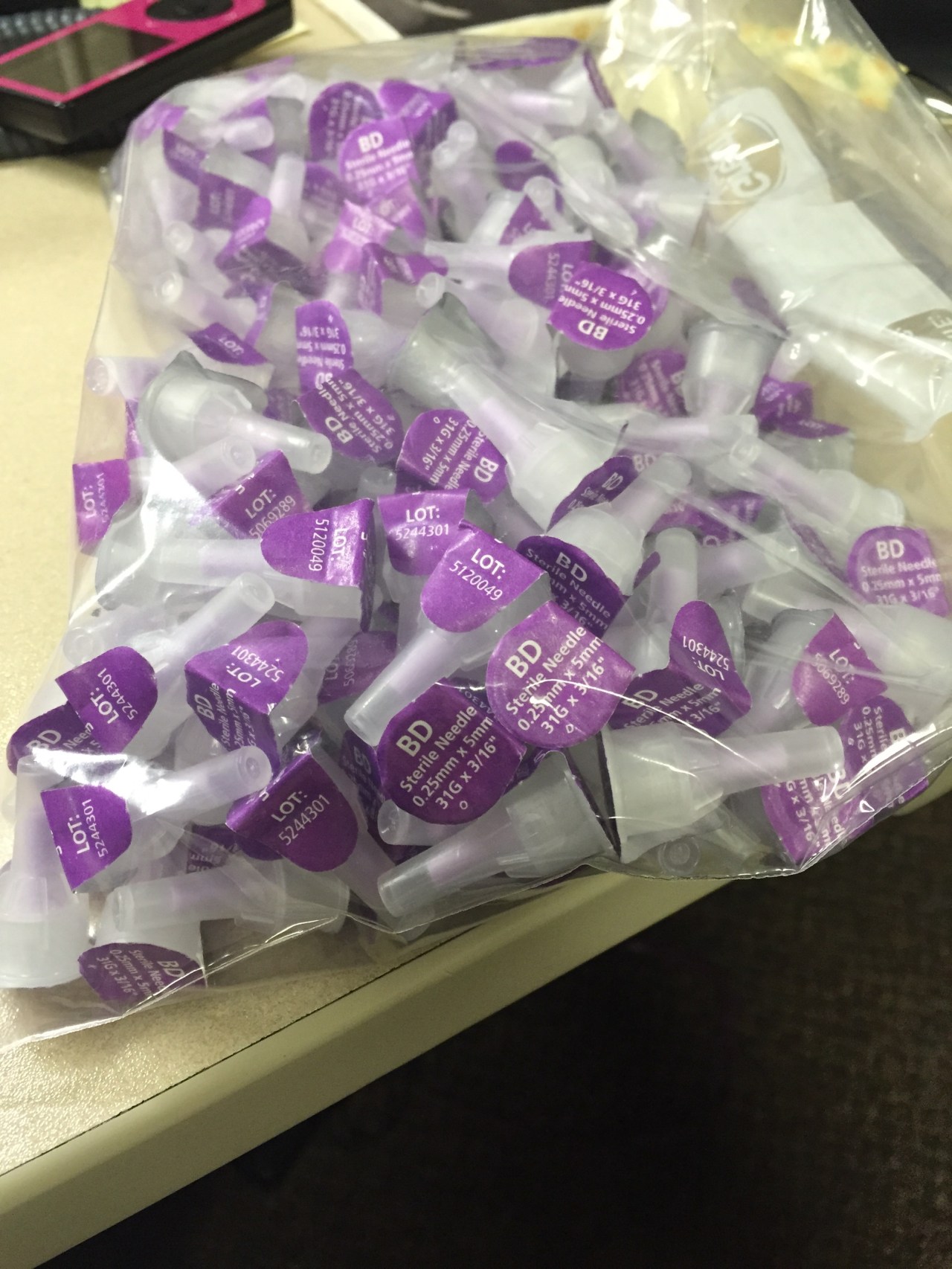
Good eggs still exist despite the healthcare loop-de-loop (see here).  One of them is my friend, who recently switched insulin types and donated his no-longer-needed BD “Mini” pen tips to yours truly.

It’s not every day that a young professional is seen skipping through the office, clutching a Ziploc baggie full of unused needles to her chest as if she had won the lottery, but I was totally okay with being “that girl” today.

To my generous friend:

You know who you are.  The little things matter in a big way.  Your kind act makes my life with diabetes literally and figuratively less painful with this donation.  Thank you…