Localized Empathy

Boston traffic sucks.

Especially in the summertime.

To save myself some unnecessary frustration, I did something that I do not normally do: booked a few local medical appointments here in Rhode Island.

Don’t get me wrong: In my graduate studies I met many nurses and healthcare folks who work in our small state and do a darn good job making patients well.  But, having begun my care in Boston at a young age, I historically stuck with the endearingly-nicknamed “Mecca of Healthcare” for my treatment.

An hour commute is a small price to pay for the best healthcare on earth.  I grew up in the Joslin waiting room, watching families fly in from all over the world to seek help for their kids.  I accompanied my #MedX bestie, Danielle Edges, and her brave daughter, Alex, when they traveled to Boston Children’s Hospital from Phoenix, AZ, earlier this year.  Trust me: Boston has it going on, and I am always cognizant of how blessed I am to live relatively close to these topnotch facilities.

The problem, though, is that my trips have not been an hour commute for as long as I can remember lately.  Between traffic coming from and going to Boston, as well as time with the provider, I am usually gone for 6 to 8 hours per appointment.  The bags underneath my eyes were growing larger by the day, and my attitude was strained.  I needed a break.

So, I made a pact with myself: For reasons of self-care, I would book some “non-essential” appointments back home in Lil Rhody.  While every medical appointment is certainly important, the urgency is not necessarily there for this local stuff, versus the “essential” diabetes tune-ups that I receive in Boston.

One hot afternoon in July, I gulped down my coffee and headed inside a RI dermatologist’s office.  I have experienced itchy-then-painful blisters on my hands since childhood, and no doctor has ever been able to crack the code.  If the best providers in Boston specializing in autoimmune disorders don’t know, how will anyone else? I naively wondered.  But, with the commute being a mere 15 minutes, it was worth a shot.

I arrived early to fill out new patient paperwork as instructed.  Parking had been easy- no expensive, overfilled parking garages.  The receptionist and intake nurse were both friendly.  And finally, it was time to see the doctor.  She was kind and concise.

“Do you have a blister right now?”

“Yes.  It’s healing,” I replied, extending my hand for further inspection.

“Oh, I know exactly what this is.  It’s dyshidrotic eczema- common in diabetics.  I’m actually shocked that you went through decades of your life with no diagnosis for this; how awful!  I’ll prescribe you some hydrocortisone creams which should help,” RI Doctor advised.

+1 for the local expert!  

I am a little miffed that Boston dropped the ball on this for so long, considering I looked like a burn victim who couldn’t hold a pencil in third grade due to the severity of the blisters.  However, I am SO grateful to finally have an answer and effective treatment options!

Then it was time for the mole check.  Melanoma does not discriminate between right arm or left arm, right butt cheek or left butt cheek.  Almost every inch of the body is observed to ensure safety.  Smart, yet still kind of awkward…

“Just so you know, I’m wearing a…” I began.

“A thong?” RI Doctor replied.

We’ve seen it all, honey, the observing nurse thought.

“Actually, it’s a continuous glucose monitor for my type 1 diabetes.  It’s on my…”

*Ten seconds later*

“Oh!  Good thing you warned me!”  RI Doctor exclaimed, having located the sensor where the sun doesn’t often shine.

As odd as it was to have a conversation while naked in a room among new acquaintances, the professionalism and thoroughness of the doctor made the experience more bearable.  I felt at ease knowing that the eczema- which has for years induced a stress response in my body, and, therefore, my BGs- would finally be tamed, and that the funky mole on my ribs was nothing dangerous.

“When were you diagnosed with type 1?” RI Doctor asked.

“Just before my third birthday.”

“And your parents caught it early?”

“Early enough that I survived.  But I was in DKA.”

And then I thought again about the little boy whose name I still do not know, who passed away from complications of T1D diagnosed too late, just a few days before my arrival in the same ER.

“Wow.  That must have been so hard,” RI Doctor wondered aloud.

“Yeah…”

“That must have been so hard.  It is so hard,” she pushed.

“It is…” I admitted.


And there it was: the truth, exposed.  Diabetes is hard.  But we’re still fighting.

Sometimes localized empathy makes all the difference.

#weneedacure


Feedback to Feed Forward

September will be here before we know it, and I am excited to share that I will be returning to Stanford Medicine X (#MedX) as a junior member of the ePatient advisory panel.  Additionally, I will be presenting in a panel entitled “Ah-Ha! moments in mental health and chronic disease management” alongside wonderful advocates Alan Brewington, Kristin Coppens, Danielle Edges, and Mark Freeman, and moderated by rockstar Charlie Blotner.

Accepted MedX 2016 presentations can be found here.  Our abstract includes the following information, some of which is quoted below:

“Mental health and chronic disease management are often interwoven topics in science. But what about the human side of the story? Whether or not individuals meet the diagnostic criteria for mental diagnoses, we all long for optimal mental and physical health to attain good quality of life.

How do we put a personal face to the feelings that hypoglycemia, or chronic pain, or other physical health struggles invoke in terms of our emotions? What moments have changed the way we think about mental health and chronic disease, and how can we encourage these same poignant healthcare interactions in the lives of others?

This panel will explore just how vital this conversation is in chronic disease and mental health management by featuring multifaceted patient, caregiver, and mental health advocate perspectives. In order to facilitate this conversation for all patients, we must raise the topic from the very source: ePatients themselves. Therefore, this panel is ePatient-centric in its selection of presenters. We will identify crucial learning moments in understanding our own mental health, while promoting a transparent discussion that remains much-needed in humanizing healthcare.

…Ah-Ha! moments relevant to the following topics will be discussed:

  • Why the words we use matter so much
  • Barriers to care
  • Continuum of “before, during, and after” mental health becomes a focus of care management; early intervention in normalizing this conversation
  • Caregiver resources and how to talk to children/teens about difficult health topics
  • Managing multiple diagnoses
  • Curtailing advocacy “burnout””

Source (linked here): MedX 2016 accepted presentations, “Ah-Ha! moments in mental health and chronic disease management.”

In preparation for our upcoming panel, we wanted to reach out to our respective advocacy communities to see if there are pertinent points that you would like us to consider and to possibly discuss in the panel (time-permitting).  I recently wrote about the diabetic online community (#doc) needing to hear more from “The Whole” in diabetes, and this is a good platform by which to reflect upon feedback from multiple sources.  While one presentation cannot represent all affected by health conditions, we can try our best to integrate community viewpoints into what we discuss.

With that said, if you have ideas about mental health and chronic disease of any type, please feel free to contact us.  We would love to listen to your perspectives!  My contact information can be found here, or feel free to comment on this post if you are comfortable sharing your thoughts publicly.

Thanks for your support!  We are so looking forward to MedX!


As promised… 🎈

“I need to refresh with a new, non-healthcare related hobby!” -me, to anyone who will listen recently

Hot air balloons filled that void.  I have always wanted to see HABs in person and was so excited to attend the South County Hot Air Balloon Festival in Rhode Island this weekend.  I hope to travel to future HAB fests, to read more about the balloons and their history, to volunteer in marketing for events, and perhaps to take a ride one day.

Hope you had a good weekend, too.  Here are some pictures from the festival, as promised.

IMG_5475

One day we will be cured of diabetes and eat #AllOfTheThings at a carnival. 

IMG_5476

#YAAAS

IMG_5477

Inside a balloon with my very first friend from college, Meg!  #gofriars

IMG_5473


IMG_5478


IMG_5479

“Teal Magnolia” showing off for the crowd.


Whole Milk With The Disclaimers

This will not be my most popular blog post ever.


You may not agree with me.  That is okay.  In fact, it is a good thing.  If we all nodded our heads along to the beat of the same drum in this world, well, we would be a boring orchestra.  Renza wrote a great piece on this notion recently, which can be found here.

One of the largest issues we face in the United States today is the “battle of the egos.”  We see it play out on our Facebook newsfeeds each morning:

“I’m voting for so-and-so and I must be right because it’s my opinion and I said so and I can scream louder than you!!!”

Yes, we have a right to say such things.  But do we really need to completely write off the other side of the opinion in the process?  If we do, quite frankly, we are only hurting ourselves.  Very rarely in life are issues so cut and dry, 100% right or wrong.  When politics falls into the gray zone, which it so often does, our greatest hope for the best world possible is to hear and consider all opinions, to put aside our personal biases and to think about what truly matters.  We are way too quick to judge.

“He looked like a thug.  He must have done something wrong.  He would have shot first.”

We do not always pause to think of the psychosocial reasons why he is in the wrong place at the wrong time, or why we are in the right place at the right time- safe from injury or premature death, judging from afar.

Or, we roll our eyes dismissively, choosing to believe a social media rant from someone who has never seen combat, or public service in a rough neighborhood:

“The cop had more than a split-second to make a life-or-death decision; his life, or the alleged suspect’s?!  He doesn’t go home at night sick to his stomach about taking another’s life, whether or not the the law supports his defense…”

We do not always concede that maybe, just maybe, in this particular case, we are speaking of a human being who perhaps acted in fear, rather than hatred.

At one point or another, we are all guilty of not placing ourselves in the other’s shoes.  It is easier for us to say that one side is 110% wrong, and we are 110% right.  If only morals and ethics were so mathematically easy…

We do not always think about how unique individuals are, how we cannot check them off like bubbles on the SAT, fitting a prescribed correct answer to each situation.  Maybe there is none.  Let’s sit in the scariness of that idea, together.  Let’s be more loving and considerate than we have been as a society in recent weeks.


Admittedly, I have been disappointed in the diabetes advocacy world for similar reasons of us not seeing all sides of the equation lately.  There are days where the #doc rallies and we do something that is so obviously good: honoring Kycie Terry this month, for example.

Regularly, we laugh together, cry together, share our lives with diabetes together.  This is what makes us tick, what gives a distinct purpose to this disease in which we are, despite it all, somehow able to rise above.

My concerns, though, echo Tom Goffe’s wonderful post regarding the impending FDA decision on potentially dosing insulin based on Dexcom continuous glucose monitors (CGMs).

***(Disclaimer: I am not a medical professional; do NOT consider any of this blog post to be medical advice intended for treatment purposes.)

My personal opinion on diabetes management is more of a Libertarian view, if we want to talk politics.  I am perfectly okay with individual patient-centricity in disease management.  Diabetes falls on a spectrum of manifestations; what works for me, may not work for you, and vice versa.  If you want to dose according to Dexcom and you are comfortable doing so, by all means, that is your prerogative, and I truly wish you all the success in the world.

Although I no longer use an insulin pump due to a freaky product defect hullabaloo that I encountered, I am happy for all of those who still have access and great results from insulin pump technology.  That same mindset goes for those who experience phenomenal Dexcom CGM accuracy and ease of dosing insulin accordingly.

Every great innovation in society has come by those who are brave enough to take risks.  Think no further than the Open APS and #wearenotwaiting folks in our own community.  Their courage, creativity, and selflessness are beyond measure.

My #DoseWithCGM worry, though, begins with this being a rushed decision.  CGM technology is not quite there yet in my opinion, and to have a trusted federal agency say that it is- under pressure from one side of the equation, rather than all sides- is a slippery slope.  

Dexcom is- again, in my own opinion- the most innovative diabetes company in the market right now; I am absolutely confident that their technology will only go up from here; but we should not compromise safety and swap out access to other products in the interim.  Generally-speaking, the government can curtail efficiency in health tech, but this is one rare occasion where it serves as a proper check and balance.  As far as CGM dosing, don’t ask, don’t tell; do whatever you want (as an informed, experienced, safety-focused patient), but leave the government out of it.

There are the obvious physical dangers to insulin dosing, at any time and using any product as a baseline judge of BG; diabetes can be a conniving JerkFace.

Sure, I have 25 years of T1D under my belt and have a good sense of the disparities between my CGM’s interstitial fluid reading, and the blood sugar reading of my meter.  But what about a newly-diagnosed family?  What if Mom boluses 7-year-old Jenny based off of the CGM’s 300, when she is really 180?  What if she is advised that this is an appropriate treatment approach by a federal agency set in place to keep her safe?

Sadly, insulin can be as life-taking as it can be life-preserving, and the reality is that it can sway from either extreme quickly and easily- through no fault of the patient’s or caregiver’s.  This disease has a mind of its own, and even technology can never truly replace a fully-functioning pancreas.  Again, #weneedacure.  A real cure.

“I guess if you ate low carb and had a steady line at 100 all day, dosing off of CGM wouldn’t be that bad considering the tiny boluses,” I said, shrugging my shoulders.

“Actually, I think that could be more dangerous.  There’s less of a BG cushion if something goes wrong,” a doctor replied.

Very true.  That, or what about the T1Ds (myself very much included), who are not always smooth sailing at 100 mg/dL all day.  Sometimes you wake up with a 55, rebound up to 224 when your liver releases sugar as the juice kicks in, correct and go back down to 78, eat lunch and sit at 162 for awhile, and  then somehow see a 340 by dinner because your menstrual cycle begins and unleashes hormonal hell on your body.  How in the heck can we ever expect a machine to keep up with that?!!

While I have seen the argument about meter reliability, I find it a weak one.  Let’s attack the issue at the root cause: meters need to improve.  But, they are still a better, more immediate guide than interstitial fluid ever will be.  Together, the two are a wonderful pair, showing us real-time data, trends, alarms, and so on.  I am not knocking either option, but I want to ensure that I have proper access to both in the long-term.

When I was normal person sick (NPS) last week, my CGM could not keep up.  Neither could I, but I used all of the tools in my toolbox, to include my own diabetes intuition, to get out of the murky waters.  Thankfully, I manually checked my blood sugar before dosing insulin at bedtime:
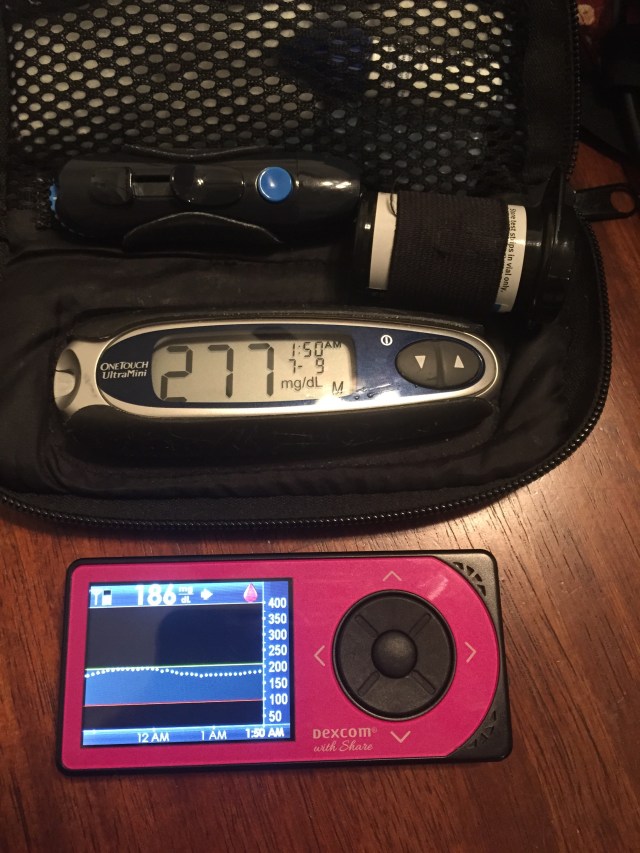
IMG_5065

I in no way want to stifle innovation by expressing this opinion.  I admire (and consider as friends) many of the advocates who are fully in support of this CGM dosing proposal.  I also respect the major diabetes organizations which are onboard.  Despite not agreeing wholeheartedly with their rationale in this case, I have no doubts that they want to see a better world for all diabetics.  We all do, in our own ways.

My experience in healthcare leads me to believe that this decision will ultimately restrict our access to test strips, as insurance agencies will look to cut costs.  And heck, as business leaders, they should; the ACA rewards and encourages cost reduction, and many consumers supported these measures vocally and at the polls.  Regardless, this is beyond anxiety-provoking for so many of us.  Test strips are ludicrously expensive already, and to imagine that we may be limited to a few checks a day to calibrate an imperfect CGM apparatus is maddening and disheartening, to say the least.  Pass the coffee.

Imagine the current healthcare loop-de-loop.  Imagine the Medtronic/UHC debacle.  Actually, do not imagine- because we are already living it.  And we know how unpleasant it is.  Now pretend that your insurance has restricted your test strip supply, and you do not feel comfortable dosing via CGM.  You have to get a letter from your endocrinologist, or perhaps a mental health care provider, indicating that you need more test strips to manage your chronic, lifelong condition which will never go away until there is a real cure.  Nonetheless, you have to jump through this paperwork hoop every 3 months, missing time from work to argue with suppliers about why you need life-sustaining medical supplies.  And maybe insurance will grant you 7 test strips per day instead of 2 when all is said and done…  While this example is (hopefully) extreme, it is still possible.  And it’s scary as heck for many of us.

“But Medicare won’t cover CGM.  Or how will this affect the Libre?”

Again, I think we are attacking the wrong sources- deflecting one issue onto many others.  By potentially limiting a test-strip-saavy demographic in the name of providing wider access to all is a total cop out.  Instead, hold our government more accountable.  CGM is a reliable tool, illustrated to be life-saving and absolutely quality of life-improving.  For these reasons, Medicare folks (or swap in folks who want Libre access), deserve to have better technology on hand.  But to substitute one option for another is silly, given that both CGMs and blood sugar meters have plenty of room for improvement in the current market.

Online polls and petitions do not represent the whole.  From a science and data standpoint, they illustrate a sample demographic from which we can make some educated-inferences:

1.) Most of these people have computer/smart phone/internet access.

2.) This enlightens us as to their ballpark socioeconomic status.

3.) That gives us some idea of their access to and quality of healthcare.

Convenience samples are fine as long as biases are disclosed.  We must say upfront that this is one side of the very large diabetes equation, and that this sample is not representative of The Whole.  While we cannot all leave our fulltime jobs or school courses to lobby in front of Congress or the FDA, those representing us should be enlightened as to how we all feel, and should act accordingly.

As Erin Gilmer has respectfully pointed out on numerous occasions, there are marginalized demographics who cannot obtain the most basic of diabetes care: dental visits, for example.  Yet we are up in arms over insulin pump collusion.  Or, in this case, CGM dosing.  The marginalized folks are not likely to be invested in this discussion because they do not have access to what is at stake; heck, they do not have access to the bare minimum.  While we raise our voices, we must take caution not to further drown theirs out.

In many of the presentations of the CGM dosing issue on social media, I saw big fish in the diabetes pond introducing the topic as, “Here, this is good, hop aboard and get involved!”.  This mindset is positive, for sure.  But we are not whole if one of us is not heard, if different viewpoints are not given adequate opportunity to be discussed.

What about the school nurse who wrote into the debate on a Facebook status post?  Did we listen when she said she would be uncomfortable dosing a child in her care at school based off of a CGM reading?  Do we care?

On the flip side, if someone has great CGM accuracy and wants to lessen the finger pricks his type 1 toddler endures, am I hearing him out?


Que será, será.  Whatever will be, will be.  Ultimately, a decision will be made regarding the FDA and dosing with CGM.  But we should all have a voice in it.

This is a long post and I surely will go to bed and realize I left out a few other big points.  But this is food for thought for now.  Although I am a little fish in the diabetes pond, it is my moral responsibility to use whatever platform I do have to improve life for diabetics.  In my personal judgment, voicing this opinion has merit towards that cause.

I also promise to be upfront about my own diabetes biases.  In the past, I have gotten on my soapbox and pledged up and down the river that we need a cure.  But perhaps I have not listened to the other advocate on the soapbox next to me, who may be more focused on an artificial pancreas and who may feel that it is too painful to believe in a cure after years of disappointment.  I have to respect that voice, too, because that person is part of The Whole.

So, here are my disclaimers:

1.) I can only represent my own opinions, but I hope that I can connect with others and help them by writing authentically and openly- whether we agree or disagree on various points.

2.) I will always hold out hope for a diabetes cure.  Even if it does not benefit me in time, I want future generations to live in a better world.  My blog focuses on this concept often, but please know that I respect everyone who strives for a better world for people with diabetes, however that world may be achieved.

3.) I will do my part to be more inclusive of The Whole.  Firstly, I will feature more about cystic fibrosis-related diabetes (CFRD) on my blog.  The CF community has so much to offer, and they have a valid seat at our diabetes table given CFRD/the risk of CFRD.  Let’s learn more together.  More to follow.


Too much skim or 2% milk leaves out a talented, diverse sample of people with diabetes.  For the time-being, instead of taking my coffee very light (with cream), no sugar, I pledge to focus more on The Whole.  

Thank you


Health Tech, Brains, and Bodies

Many thanks to my Stanford MedX friend, Mark Freeman, as well as Matt and Daniela, for having me on the Everybody Has A Brain podcast to chat about wearable health technology.

These awesome folks are responsible for one of my favorite healthcare takeaways: Everybody has a brain.  If you have a brain, then you have mental health.  Let’s normalize the conversation, then.

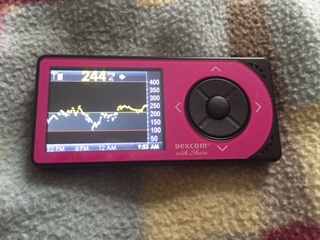
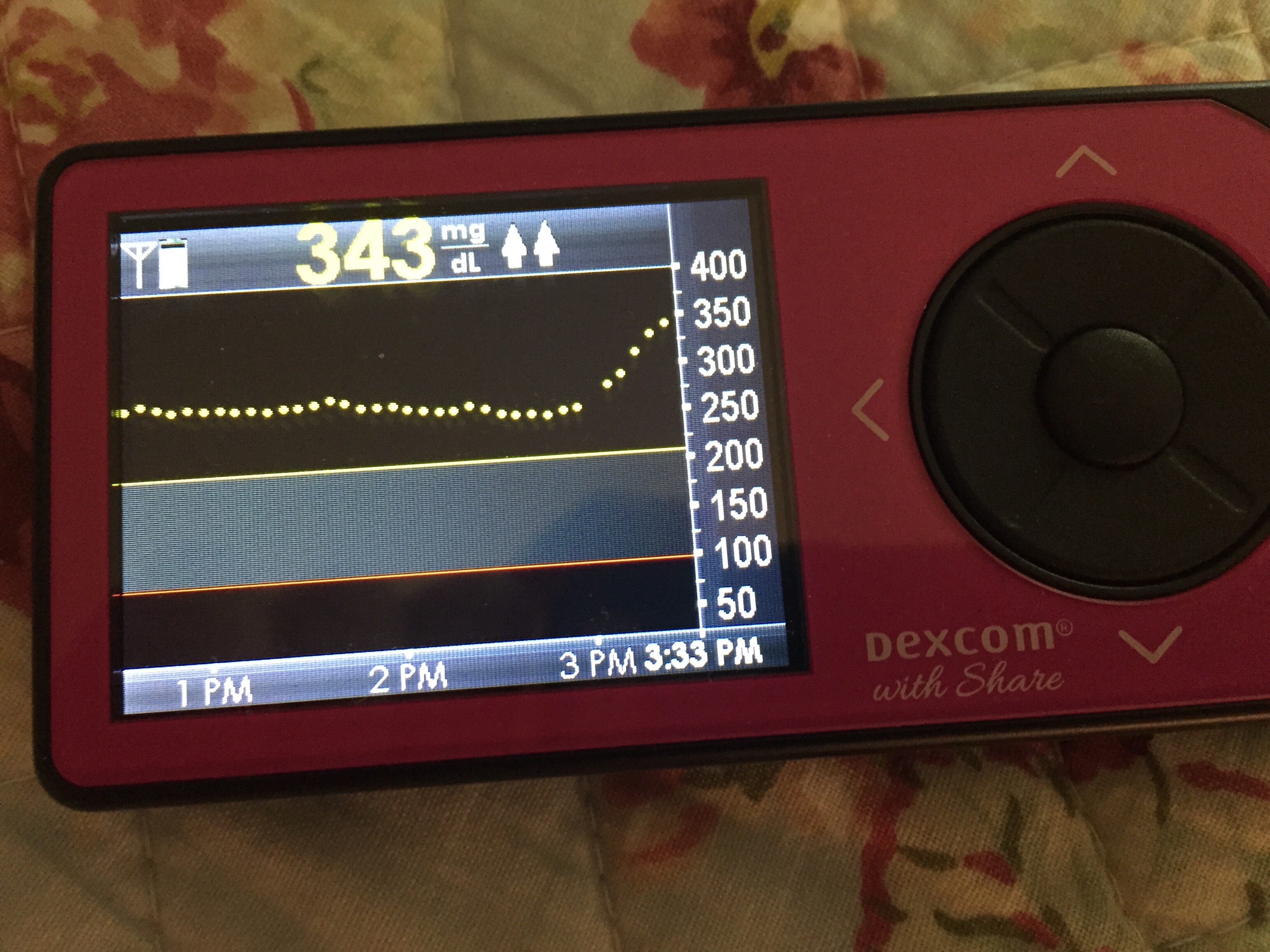
Mark and I discussed the pros and cons of my Dexcom continuous glucose monitor (CGM) experience, to include physical and mental components of using health technology.  I even sent along a not-so-perfect CGM photo to illustrate the sometimes-wonky T1D reality of Dexcom alerts.  Matt and Daniela then continued the chat on wearables.

Please take a listen (link below), and check out everybodyhasabrain.com to see other cool content.

Everybody Has A Brain podcast

“Survey Says…?!”

***Update: The survey is now closed. 

Thank you so much to everyone who participated and/or helped to spread the word!

Diabetes folks, please consider participating in my research survey, which can be found here:

Very Light, No Sugar Survey 2016


Please read the bold text of the cover page, as it is very important to our data collection.

Sharing is appreciated. Thank you!


Kangaroo Krazy Dreams

My insulin pump administered ten units of Humalog in my sleep!  I must have rolled onto it the wrong way, and the buttons got pushed!  HELP!!!


I splurged.  I drank the entire island-themed mixed drink with all of the sugary syrup, and I forgot to bolus.  Where is the insulin vial that’s normally bouncing around in my purse?


My meter says “HI” but it’s not the same friendly “Hey what’s up hello” a la everyone’s favorite rapper, Fetty Wap.  I could drink an entire gallon of water.

IMG_4697 


“Your GFR results were funky.  We’re going to do this Fancy-Sounding-Medical-Test to further evaluate things.  The nurse will be in soon with a mile-long needle to stick in your back.”

“Can’t we wait a minute for Dr. Z to arrive?  I don’t want to do this before talking to her.”

“This is healthcare, honey.  Time is money.  We can’t wait for another doctor.”


“What are you doing?!!  Why would you pull your car over in such a dangerous location?  There is a blind spot around this curve in the road!  Another car could hit you!  So, so stupid!”

“I’m low.”  Even if I’m not low, maybe that reasoning will be enough to make him stop this time.


Must. have. food.  Hamburger. Fries. Soft serve vanilla ice cream.  Anything.  The words aren’t coming out when the cashier rings me up…


I’m so tired of needles.  It’s not even the momentary pain.  It’s the voluntary submitting of myself to another human being whose societal title raises him or her “above” me.  Doctor.  Patient.  Needle.  I’m not signing up for this again.  One month off from appointments won’t make or break my health.

But then the baby kangaroo hopped over to me.  Overcome by its cuteness, I hugged it tightly.  Baby Joey reacted by biting my hand, slicing into my thumb.  Mom tried to catch him so we could test for rabies, but he bounced away into the woods.

Rabies shots?  No, please no more needles.  Can we just wait a little bit?  My doctors will be back from vacation soon and then we can move forward with the shots.  This is supposed to be one month off!  Please!  I promise I’ll be good.


baby kangaroo giphy

Source: giphy.com


I always assumed other diabetics dreamed about diabetes as often as I did, until an impromptu and unscientific Twitter inquiry informed me otherwise.  Some #doc members replied that they had only dreamed of diabetes once or twice; others shared a few humorous tales inspired by overnight hypoglycemia.

[After-Publication-Note: The above-mentioned were just dreams.  All is well.]

I am in the Twitter minority that dreams of diabetes on a weekly basis.  The snippets illustrated above come back to one resounding theme: There is an emergency, the odds are against me, but I somehow am responsible for getting myself out of trouble.  Life with diabetes in a nutshell, if you ask me.  We just look pretty damn brave while we live it every day, so others do not always notice our superhero capes.

Along with some valuable assistants, I have moved mountains to quell my anxiety in recent years.  Anxiety will always be there, but it does not have to be the loudest voice in my head at all times.  What saddens me with these regular, scary dreams is that my body is subconsciously in survival mode even when at rest.  Diabetes never sleeps, and neither do we.

The good news is that these dreams have value.   The incessant cravings in the McDonald’s line?  Yup, my body is signaling that my blood sugar is low.  Eventually a light switch goes off and I jerk awake, covered in sweat, just in time to hear the CGM alert going off and to gulp down the juice on my nightstand.

The kangaroo?  Well, I have to be honest with myself: Although I appreciate the wonderful healthcare I receive in Boston, everyone needs a break at some point.  I recently booked a few non-essential appointments closer to my Rhode Island residence in an effort to cut some traffic corners where I can.  For now, I’ll reserve Boston for the vitally important appointments only.

But as much as I want to pretend that I can handle all of this on my own right now- during the self-prescribed “month off”- the reality is that I still need the support of my healthcare team.

Can’t we just wait for my doctors and nurses before the rabies shots?  Can’t they just take it all away- diabetes and injections and highs and lows and fear- just for a few minutes?  Please. 

I don’t say it enough, but I’m braver with their help.  


Ally-gator Scratching for Answers

A few weeks ago, I attended some follow-up appointments at Mass General Hospital (MGH) in an effort to identify allergies that may be triggering an inflammatory response in my body.  In other words, #JustSayNoToKetones, random fevers, crappy BGs, and the typical symptoms of a type 1 diabetic’s response to the dreaded “normal person sick” (NPS).  A WordPress glitch is not allowing me to link to content tonight, but the background to my MGH visit can be found by searching for the blog post “Sleuthing” on verylightnosugar.com.

In April, a scratch test confirmed what we already knew.  I am allergic to the following culprits.  Do not let their pleading-innocent faces fool you in their mugshots!


IMG_2823

 #WhoMe? #TootsieWithTheGoodFur

IMG_3087

#FreeAceDog

IMG_4396

’16 Bonnie & Clyde

IMG_3058

Scratch test and shoe game

We scheduled more intensive allergy patch testing in June, in which potential household irritants are temporarily placed on the skin to elicit reactions and identify allergy triggers.  I visited MGH on Tuesday, Thursday, and Friday, logging hundreds of miles on my car and refreshing my memory on just how difficult Boston traffic is in the summer.  I averaged 2 hours on the way there and 3 hours on the way back to Rhode Island due to traffic.

On Tuesday, a nurse placed the patches on my back.  She carefully explained each step in order to keep me calm and informed.

“Now I am going to clean the area… Now I am going to dry off the area… Now I am going to place the patch.  It’s like a big sticker… Now I am going to secure the sites with tape… Now I am going to draw around the sites with marker so we can track the reactions and the locations… You may feel a little itchy… Do not get the sites wet or super sweaty… Try not to scratch so we can examine things clearly when you come in again… Call us with any problems…”

“That’s it?  I’m free to go?!”

And off I went for 48 hours of fun.

IMG_4450

I’ve always wanted to say that a crocodile, an alligator, a Great White Shark, a mountain lion, or a bear bit me.  Seize the day, folks.

The sites were a little itchy, but nothing unbearable.  In true diabetes form, my skin was more agitated by the medical tape than anything else.  Eventually I could tell that a baseball cap and perfume overload were not going to cut it; I needed to wash my hair without getting my back wet.

The first attempt in the kitchen sink resulted in me inadvertently mopping the floor with my soaking wet hair.  I moved on to the shower, my back carefully padded with towels and sweatshirts to avoid contact with water, which would jeopardize the test results.  I craned my neck into the stream of water and scrubbed as best I could.  The next day resulted in a “hat day” as well, my hair a total Punky Brewster disaster.  Shout out to the Betes On Tap crew for sitting next to the smelly girl at happy hour.  You are good for the soul.  🙂

On Thursday, I returned to MGH for the patch removal.  A nurse gently peeled off the tape and then the patches, always cognizant of how much her patient was flinching in the background.  The skin is understandably angry after all of that, so a 20-minute waiting period takes place before the sites are examined to allow the skin to cool down.  One of my top ten favorite healthcare interactions of all time resulted:

“Try not to scratch, okay?  I’ll be back soon.”  -Nurse

“Okay.” -Me

*Frantically scratches back as nurse leaves the room*

20 minutes later:

Nurse, lifting patient’s shirt: “Did you scratch…?”

“No…..I mean, yes!” -Me

Now I know how Tootsie and Ace feel: guilty as charged.

Further examination revealed some irritation to certain patches.  The nurse bid me farewell with strict instructions not to scratch at home.

On Friday, I met with the doctor.  The skin irritation had quieted down at that point, and she did not believe that I was reacting to the patches we tested.  Further testing of a wider range of patches was recommended.  TBD what that will reveal… But at least I’ll know how to wash my hair better for the next time.

We also did a penicillin test, which involved scratch testing of the skin, shots, and eventual ingestion of penicillin.  Being a healthcare nerd, I know that penicillin allergies are often misdiagnosed or that patients will outgrow the allergies, and I was hopeful that the one time I broke out in hives and ran to the bathroom every few hours while taking penicillin in college would be a fluke.  It was.  Your girl is free to take the antibiotic again, which is nice to know in case of any serious infections in the future.  Now to update my MedicAlert bracelet!  I will bask in the glory of removing a medical jewelry condition rather than adding one this time around!

I took everything in stride the week of the appointments, mostly because of the superb care I was so blessed to receive at MGH.  The appointments ran on time; I was seen by an expert in the field; the nurses were considerate and thorough; the receptionists were friendly; a volunteer greeter walked me to the elevator I needed; just wow.  From the moment I stepped foot in the main lobby at MGH, I was treated respectfully.  I was not just a patient.  I was a human being.  Just like everyone else in the building.  This is a welcome change from some of my experiences at other facilities, and I urge those clinics (you know who you are) to take a page out of MGH’s book.  There is a reason why MGH is repeatedly numero uno.

The following week, exhaustion and burnout reared their ugly heads, and I was just… done.  Done with diabetes, with healthcare, with publicly sharing my health story, with traffic, with pretty much everything.  I wanted my privacy and my identity back- to not submit myself to one more needle poke or to being a patient incessantly pingpong-ing around the healthcare system.  Alas, after lots of sleep and lots of time spent in good company, I can see the light more clearly this week.  I am extremely fortunate to live near Boston and to receive topnotch care.  It is okay to be tired.  But I have to keep going, not allowing health woes to take over; rather, to know that I am trying.  We all do this because we have to.

Goodnight.  Don’t let the scratch tests bite.

-Ally-gator


*My condolences to those mourning the loss of friends and family members from the diabetic online community this week.  I hope that this blog post provided some comic relief, but on a more serious note please know that you are all in my thoughts and prayers. 

#weneedacure


Coloring Book

Bruising happens.

Black-and-blues are inevitable with multiple daily injections (MDI) considering the sheer number of times we must poke ourselves each year.  None of this is natural for the body to endure, but it is necessary.

As I flinched while a nurse removed bandages from my back at a recent medical appointment, she paused and asked if she was hurting me.  “It’s okay,” I mumbled, more concerned that my tough exterior was noticeably crumbling down than I was about any physical pain.  After the initial diabetes diagnosis shock at approximately age 3, I bottled up my emotions in order to survive.  We might need a stronger corkscrew to open the floodgates at this point…

The visible reminders of insulin injection bruises on my abdomen are an aspect of MDI that I grapple with emotionally.  I am forced to admit that diabetes is right there looking back at me in the mirror, and that sometimes it does hurt me whether I want to concede that point or not.

Admittedly, this is a morbidly weird artistic endeavor.  But I decided to have a little fun by altering a photo of Mega Bruiseasaurus, which has camped out on my stomach just in time for bikini season.  The bruise’s purple hues became a sea turtle’s shell, and my jeans morphed into the water in the background.  Inquisitive face, green limbs, and a pointy tail sprouted up through the hard shell, determined to show off the good stuff that diabetes sometimes clouds from our views.  Bruiseasaurus is no longer the greatest creature in the jungle.  Sally the Sea Turtle has marked her territory, too.  She is the life of the party, after all.

sea turtle bruise pic