If you can’t beat ’em, join ’em.

Random middle of the night thoughts, to the tune of Flo Rida’s “Low”:

Shorty got those apple juice dreams,
Snacks are not a cureee,
The whole fridge was eaten by herrr.
Glucose hit the floor,
Next thing you know,
Dexcom flashed low, low, low, low, low, low, low, low…

Broken Record.

002002

Disclaimer: Before we really dive into things, you should know that this is a lengthy post, and it may not be all rainbows and sunshine.  Read at your own risk.  I personally hope that you are feeling a bit adventurous as a reader today, though. 🙂 

When my mother was in second grade, she was running through the auditorium and accidentally dropped her Bambi record on the ground.  It shattered into tiny pieces, and the janitor swept them up and gave them to her in a plastic bag.  She walked home sobbing and was heartbroken when gluing the pieces back together did not make the record work again.

If I told that story to a child today, she would laugh in my face and say that my Mom should have used an IPod instead.  Fair enough…

Well, I have become a broken record myself.  I know it and everyone else knows it.  I don’t even want the attention.  I just want the simple act of screaming my lungs out when I’m angry, and it usually comes disguised as some sort of social media rant about stupid drivers on the way to work or something else that is irrelevant.  I have lost friends over it, and I say this to my doctor all the time: Although diabetes is to blame for many bad moods, at the end of the day, I still have to answer to God and to the people in my life.  Diabetes isn’t a good excuse, then.  I can still be a respectful human being despite diabetes-induced mood swings and frustrations, and I need to work on this. I’m trying, which has to count for something.

But it is also very difficult to describe to people what stubbornly high blood sugars feel like and what a physical and emotional ass-kicking it is when nothing you do works to solve the problem. This is my reality on many days, and I imagine some of you reading this understand exactly what I mean. I hate to say that this type of suffering has changed me, but in some ways, it has. I am always on edge about how I will prevent and treat these highs, and I don’t remember the last time I just let my guard down and enjoyed the moment- probably because I was nursing a high blood sugar back to health in the background of that moment, with everyone around me remaining oblivious.

Many people have “yessed” me to death in regards to my insulin pump struggles, including family members. “Are you really just going to say ‘I know’?!” I scream on the phone with Mom. I get upset with this response, but I also understand it from a psychological perspective. There is really not much that others can do to help. They are not the ones up all night changing pump sites any more. They do not have to go to work exhausted and seeing spots because of high blood glucose. As much as they try to “get it,” they can’t completely comprehend what it feels like.

Some others have told me to toughen up or that it’s in my head, including fellow diabetics. I have a much more difficult time swallowing humble pie at that point. That advice adds nothing to the equation; it is the same as telling a depressed person to simply be happy. If life were this easy, there would be no depressed people, and there would be no sick diabetics. This is a “cop out” sort of commentary. It is much more beneficial to the friends, patients, coworkers- whoever is struggling- if we assure them that we believe them and that we are hopeful that they will find solutions. Dumbing down the problem by dismissing it as “it’s in your head” only angers that person. And guess what? It’s probably not in his or her head, especially if the person involved is a type 1 diabetic. We know our bodies better than most people do, and we know when something is awry. If you are a type 1 diabetic who has been lucky enough to avoid insulin pump problems, well, please cut us some slack that we have not been as fortunate.

Anyway, this is the blog post that I’ve owed you all.  I am BEYOND frustrated.  Forgive the length of this post, but I have to get all of the information out there. Bear with me while I go over the details, and then I really, truly need your expert advice, especially before I meet with a pump representative and my nurse for a troubleshooting appointment in two weeks.  I pinky promise that if I can ever help you in return, I will do whatever I can to pay it back, or to pay it forward. If you’re participating in the DOC, then I already know that you’re an expert, so please, please chime in here if you can help.

I am 26 now, and I went on a Medtronic MiniMed insulin pump about ten years ago while in high school.  It immediately changed my life for the better.  No more shooting up insulin doses in the bathroom stalls, no more limiting my food intake, and so much more freedom.  As my nurse would say, I had “virgin skin” that had never been pierced by insulin pump sites, and my absorption was great.  Once in a blue moon I would experience a technical issue, but this happened twice a year or so.  (I understand that an insulin pump is technology and it is not perfect.  Although if I could go back in time, I would erase the failed pump site on the one day of my life where I decided to try an iced mocha sugary drink thingy from Dunkin’ Donuts…).

Anyway, while in college, after my body experienced some wear and tear from the pump, I started to have site issues more frequently. On my twentieth birthday, I indulged in a pizza dinner with friends and had some ice cream for dessert, only to discover a bent cannula afterwards and a blood glucose reading of over 500 mg/dL. It’s my party, and I’ll cry if I want to. I also experienced some severe lows in which the whole world felt like it was falling down around me.  I was spooked- by the highs and the lows.  I had to figure out a way to stay between the lines- not too high and not too low- easier said than done with type 1 diabetes, as we all know.

According to my doctor, I literally experienced trauma from the “extremes,” the severe highs and the severe lows. This mental trauma has changed my reactions to things, has made me live a hypervigilant life in order to survive.  My brain was in fight or flight mode when these adverse situations happened in college.  I flew away from carbs.  If I ever have a kinked cannula again, at least I won’t make the mistake of eating pizza on top of it (as if anyone knows when they have a kinked cannula). If I eat salad and protein instead, maybe my sugar will be 300 instead of 500 if that happens.  And so I lived, for many years.  Until my body started to scream that it needed fuel, and it burned fat in place of carbs, and I saw ketones quite often.

I still struggle with working an adequate amount of carbs into my daily diet and with taking a more liberal amount of insulin, but I am trying. I have a phenomenal doctor who doesn’t make me feel stupid about my fears.  In fact, she makes me feel brave for showing up at her office to fight those fears.  There are some days where we are literally high-fiving and prancing around the room because I ate a half of a sandwich when my sugar was already 250 and I took quadruple the amount of insulin that I would normally take, which is usually still not enough.  But it is one giant leap for Ally of Very Light, No Sugar, so we celebrate those moments heartily.

What is making this process even more complicated is the fact that the majority of the time, I experience some sort of problem with my insulin pump and we cannot trust in the delivery mechanism for insulin. So, not only am I petrified of highs and lows, but I am constantly questioning whether the pump works or not.

I want to go on the record and say that I really like Medtronic MiniMed as a company. In my ten years of experience with them, the customer service has been top-notch.  If I need a supply, it is at my door within a day or less of placing a phone call.  Their phone representatives yield calls at all crazy hours of the night.  Their PR team does a great job of answering questions.  Angie, in management, has spent hours on the phone helping me investigate my pump issues.  I will not forget how she moved me to tears with a simple question a few weeks ago: “If you’re putting the pump site in your back, and you’re already on the thin side… well, doesn’t that hurt you…?”  Um, yes.  That part of it gets lost in the shuffle when you just want to absorb the medicine going into you, but the human connection was there.  She was clearly upset that I was in pain.  As was the Medtronic representative at my diabetes clinic who helped me with various sites last year and was a wealth of knowledge regarding all aspects of insulin pumping.  I’ve said it before and I’ll say it again: Medtronic doesn’t like bad pump days just like I don’t like them.  We are all in this for the greater good of living well with diabetes.  Alas, we have to fix these issues, for the sake of my health and for the sake of current and future insulin pumpers who may experience similar issues.

Anyway, I started off with the Quick Set infusion sets years ago, but had to switch off of them due to kinking cannulas. The Silhouettes, which have a larger cannula, worked slightly better, but my sites were so irritated that a nurse, upon seeing a picture of one site in my phone, in no uncertain terms told me that I was never to use them again.  I was allergic to some of the material, making absorption of insulin questionable due to the agitated areas.

The Sure T site, which uses a stainless steel needle that inserts into the skin and looks like a thumb tack, has been useful in that it has cut out the kinked cannula problem. Because the needle stays under your skin and you need to be able to disconnect the pump for various activities like showering, there are two attachments to the Sure T.  See photo above; disregard “love handles,” please.  One long tube connects to the reservoir in the pump.  There is a small needle at the end of this tube.  This small needle clips into a connector site, which is attached to a smaller tube running down to the needle under the skin.  To remove the pump, you detach at the main connector site.  I have had a few bizarre occurrences where the sites were snapped together but insulin was pooling at the connection instead of going through the smaller tube and into my body through the needle, causing me to spike high ketones.  Medtronic promptly replaced all of those lot numbers for me and is investigating the issue.

I am also relatively thin, so it is hard to find areas with enough fat for the sites. I never used to experience much pain with site changes, but now I feel significant shooting pains, sometimes lasting for days and making me nauseous.  My health care team has retired my stomach for sites to give it time to heal.  I sometimes use my sides and have experimented with the lower back but have not had great results so far.  Upper butt works okay but tends to be quite painful.

I feel like I have seen the whole spectrum: from pain-free, easy site changes years ago to painful, troublesome sites in recent times. I know that I am not crazy, that I am experiencing problems that are really disrupting my quality of life.  With each bad site change, I am often on the couch chasing ketones away all day and taking manual injections on top of changing out problematic pump sites.  It is no way to spend one’s mid-twenties on a weekly basis, and I want this to change so desperately that I am willing to try pretty much anything.

I would like to continue pumping because of the fine-tuning that the pump allows. I can take my mini-bolus at the beginning of dinner and bolus more ten minutes later if I go back for seconds.  I can tweak my overnight basal rates, etc.  While I do not remember seeing ketones often with multiple daily injections (MDIs), I do not like the thought that once that insulin is in you, it’s there for the day.  And if you need to bolus, it is a bigger deal to get the dose right on the first try so that you do not have to take more shots later on.  Socially, it is simpler for me to press a few buttons on a pump while in grad class late at night than it is to go to the bathroom to take a shot.

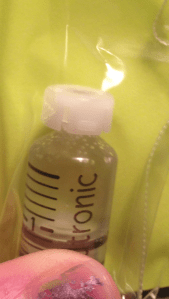
My final issue is not with the pump itself, but with the insulin. I have used a pump for years; there are usually a few pesky bubbles which can be flicked away and forgotten about.  But lately, it’s like the insulin is feisty before it even gets inside the reservoir.  See photo above.  Millions of tiny bubbles shoot around my Humalog bottle.  I have tried new orders of Humalog, attempted using different bottles, etc.  Nothing changes the presence of these bubbles.  When I fill the reservoir, I flick out the big bubbles, but usually a few tiny culprits hang out by the top of the reservoir and refuse to move.  Over time, they expand, blocking proper insulin delivery or causing some air, instead of insulin, to be delivered.  My sugars will run high for hours until I figure out the issue.  I recently gave Novolog a try, but the first two attempts yielded big bubbles as well and my sugars were high for days.  It is as if the bubbles compromise the efficacy of the insulin, and it is so not cool.

As noted earlier, I am meeting with my nurse and a Medtronic representative in a few weeks to go over all of this and to walk through the process with them to see if we can identify the issues. In the meantime, I ask for your prayers and your advice.  Some of you have reached out to me about the bubbles and you have made me feel so much better in knowing that I am not a lunatic, although I truly wish that none of us had to suffer through these circumstances.  A lot of times people are quick to blame the user.  Maybe there is user error?  If so, I’m willing to admit it and move on.  I just want to feel healthy again and to regain the quality of life that the pump originally afforded to me.

I apologize for the broken record-ness, but I am fighting for my health here.  It is disheartening when you are making big strides in your diabetes management to tackle your fears, yet something as simple as a few air bubbles is wreaking havoc on your control.  I am incredibly concerned about the toll that this is taking on me physically and mentally, and about the burden it is placing on my family and friends who want to help but don’t know how.  Perhaps you hold the answer, DOC.  In fact, I’m sure you do.  What works for you?

Wordless Wednesdays.

007

Alright, if you haven’t noticed by now, I always need to add a “few” words, but this is my attempt at copying the “Wordless Wednesdays” posts that I’ve seen on some other blogs out there: 

Gearing up for Diabetes Awareness Month in November.  I have a feeling the DOC is going to make some noise next month, and rightfully so…

Happy One Month Anniversary!

Wow- it’s really been one month since Very Light, No Sugar got dropped off by the stork and fell into the internet world?! First of all, I want to say THANK YOU to everyone who reads my blog. While I am probably not a blogging superstar by any means, I am happy to report that SOMEONE OUT THERE READS THIS! That, in and of itself, has helped me immensely to not feel so alone with diabetes.

The same concern from the very first day of kindergarten- “Will anyone like me?”– translates over into adult life, too. So, to those who do like me, thank you. It is a pleasure to get to know you through our shared connection of diabetes, and through the general connection of our roles as human beings supporting one another. It has been quite therapeutic to have someone to talk to here, to hone my writing skills that my talented English teacher, Ms. O’Neill, spent countless hours instilling in me during high school, and to connect with all of you. I have thoroughly enjoyed reading your blogs, your tweets, your Facebook posts, and the like.

On the bad days, you are the motivation to keep on truckin’. On the good days, I am happy that we all celebrate our moments of victory together. I have learned so much from you- more than any medical book could have ever taught me. You helped to troubleshoot my pump issues, analyzed proper sick day protocol, and so much more. Your wealth of knowledge of one of the most complicated diseases out there never ceases to astound me. You know diabetes because you live diabetes. You cannot put a price tag, or even a graduate degree, on such intimate understanding of a chronic illness. I wish that we did not have to comprehend exactly what the other person means when it comes to diabetes, that we did not have our own diabetes vocabulary, that this would be cured overnight for us, and that none of us had to suffer difficult times. But if we have to go through it, I am so happy to be doing so with some of the best people around.

My one regret is that I did not start this process sooner. I suppose I had to build up the confidence to give it a go, and I am so happy that I did. It helps that those in the diabetic online community (#doc) were so welcoming in letting me be a part of their diabetes social media advocacy (#dsma) efforts by expressing what being diabetic means to me. I promise to pay it forward to other “newbies” in the future whenever possible. I want to specifically express gratitude to Craig @HumnPincushion and Jere @integraljere for rooting for me in the very beginning. Sometimes all it takes is knowing that you have a little support out there, and it gives you room to grow. You both exemplified this for me, and I have learned a lot from your kindness.

Cheers to you all, and keep doing what you do in terms of our ongoing diabetes discussion. It means something to someone out there, especially on the sick days.

Thank you for coming into my heart. You’re officially stuck there, just saying.


Love,

Ally

Are you there, God? It’s me, Very Light, No Sugar.

Did you just laugh?  Because God did.  Or I like to think He did.

I know God is there.  I know people from the diabetic online community are there, partly because I tweeted that it was 3:00 am and I was awake and frustrated with diabetes and I knew that people from the #doc were up, too, and it got a few favorites rather quickly.  It’s funny how those simple gestures can make one feel less alone.  Excuse my rapid-fire Twitter vent session following that tweet, but I’m tired and I’m aggravated and maybe this blog post should be called “My Stream of Consciousness Regarding Diabetes at 3:48 am is actually ‘Very Dark, Corny Humor'”?

Well, this is real.  This is what those #FreeDiabetics pictures portray without sugarcoating it.  We all want to be free and we deserve to be free.  This is the side of diabetes that society doesn’t often see; this is the suffering that I wish none of us ever had to endure.

I’ve been on the phone with diabetes companies all week trying to sort out insulin pump problems that I am having.  I owe ya’ll a blog post about that, I know.  Consider this the precursor post.  We are troubleshooting every element to see where the problem arises.  Is it the infusion sets?  Is there a product defect?  Is the pump functioning properly?  Is the reservoir releasing insulin correctly?  Am I inserting into scar tissue?  Muscle?  Am I sick?  Am I stressed?  These are the constant questions when something goes awry with diabetes; rarely is the culprit caught red-handed.

Ketones are my nemesis.  They make me buckle at the knees and revert to being a whiny, miserable child.  Even small amounts of ketones send me straight to bed.  Unfortunately, with all of these issues going on in the background, ketones rear their ugly, ketonic heads quite often nowadays.  It is a testament to how great my nurse is that she is one of the only people who I can definitively tolerate in these moments of weakness.  Well-intentioned friends and family members are unjustly used as scapegoats for my anger when ketones appear.  It is easier to allow a nurse or a doctor to tend to the invisible wounds.  Alas, they are in Boston and I am in the Providence area, so it’s Ally versus the Ketone Crusader at what is now 4:00 am.

I struggle with taking in a lot of carbohydrates during the day.  Years and years of traumatic experiences- from inadvertently taking too much insulin to having a bent pump cannula while eating pizza which led to a blood sugar above 500 on my birthday, etc.- have led to a “fear of extremes,” as my doctor put it.  We’ve all been there to some degree.  But I am being honest with you all in that I am somewhat stuck there right now.  I go to the doctor all the time to work on this.  Part of the process comes with trusting my insulin delivery mechanism.  Let’s narrow down the potential problems list until we find something that works in terms of insulin pumping, and then we have to work on ingesting more carbs and properly dosing insulin once we can be confident that insulin is delivered.  Back to the basics.

I do not want to go to bed with my stomach growling anymore because I am afraid of eating a big dinner on top of a potentially-faulty pump site.  I promised my doctor last week that I was going to try, that I wanted to do this.  “I do not want to go to bed hungry at twenty-six years old, and that’s one thing I can commit to changing,” I said as she smiled and nodded, proud of our progress.  But tonight I did go to bed hungry.  I had eaten a larger than usual dinner (but still not large enough) and changed my pump site afterwards, while then babysitting my blood sugar as it slowly but surely went up and up.  My stomach churned as ketones formed, but I convinced myself that they were not there and went to bed, ignoring the persistent emptiness in my gut by sleeping it off.  Later I woke up with a ketones level of 1.2, probably a combination of my body burning fat for fuel in its hungry state as well as a bad pump site…  again.  This happens on a weekly basis, hence the ever-growing bags under my eyes.

Back to the drawing board.  My goal tomorrow (well, later today at a normal hour) is to eat more carbs and take a “perceived risk” by dosing more insulin with my spiffy new pump site once I wake up in a good range and know that the site is doing its job well (fingers crossed).  I would greatly appreciate it if anyone who has gone through similar trials with insulin pumping and low carb intake would offer advice, whether in comments here or in private messages.  (See Contact page on the blog).  I know that I’m not crazy, that there truly is a problem going on even though I feel like a broken record talking about pump site issues, that someone out there has to relate to this somehow.  Please, help a diabetic Sista out.  If I can pay it forward in any way at a later time, or even if this post resonates with you in some manner, my work here is done for 4:30 am.

Time to go count diabetic sheep.  Goodnight, #doc.  And thank you for listening.

#FreeDiabetics

I love this movement because it is short and sweet (pun intended).

Check them out at:   https://www.facebook.com/freediabeticsmovement   and   @freediabetics_

We live in a world very much capable of finding a cure for diabetes, but it will take lots of prayers, research, financing, and determination.  Until then, diabetics are imprisoned in a state of constant vigilance regarding high and low blood sugars.  There is no parole when it comes to type one diabetes.  #weneedacure

FreeDiabetics3

Side Note: Very Light, No Sugar suggests looking at Faustman Lab at Massachusetts General Hospital and donating whatever you can- even the $2.00 that you would normally spend on your morning coffee- to help us to one day rid the world of diabetes.

Home

Don’t Cry?

As type one diabetics- many of us diagnosed as children- we learned from a young age to be tough.  Grown adults cried like sissies getting their flu shots at the health clinic while we stood still with stoic faces.  One of my strongest memories is of my first endocrinologist’s office. I had just turned three years old and was getting accustomed to insulin injections and finger pricks. This particular office in the Worcester, MA, area performed A1C tests by drawing blood from their subjects’ arms with syringes and then sending the samples off to the lab. Pretty caveman-like if you ask me…

Well, I was three years old and a few nurses were pinning me down to stab me with a long needle. Naturally, I cried. We went back to that office a few more times. I can still visualize the indoor playground they once had in their waiting room, until someone became fearful of liability and it was removed. My mother tried to comfort me, telling me to be strong. “Try not to cry,” she said. What else could she really say? I was going to get shots for the rest of my life, so the sooner I learned not to fight this concept, the better for all of us.

At the next appointment, I bit my bottom lip and braced myself for the impact of the syringe in my tiny arm. I didn’t cry my usual amount, but I whimpered a bit.

“I didn’t cry!” I proclaimed as we walked through the parking lot afterwards.

“You didn’t…?” Mom asked.

She was not trying to come off as cold, but was rather incredulous at how my young mind had just rationalized away all of the tears flooding the examination room a few minutes earlier.

I had the three-year-old version of an “Ah ha” moment, in which I realized that okay, I had cried. But I wasn’t going to cry anymore. I resigned myself to this fact, and at the next appointment I did not cry. I had accepted my fate in some small way; shots were here to stay.

Shortly thereafter my parents took me to the renowned Joslin Diabetes Center in Boston, a decision partially prompted by the fact that their A1C tests were performed with simple finger pricks as opposed to modern-day torture tactics. Over two decades later, I am still a Joslin girl. And I still fight back my tears sometimes, but I am slowly learning that it can be healthy to let them out once in a while, too. There is certain strength in vulnerability, in showing that you hurt emotionally and/or physically but that you are going to get through that pain.

I cannot speak for every type one diabetic out there, but I would venture to guess that some of you have difficulties letting your guard down at times, too. How can we complain about a head cold when we have endured thousands and thousands of injections over the years? I can’t believe my boyfriend is upset that he lost his football game! Seriously?!!  But the reality is that these are human emotions and normal trials and tribulations of life, even if these situations are not a life or death fight as diabetes sometimes can be. It is more natural to express what you are feeling than to avert your eyes to the ground while feverishly blinking back tears. Trust me, I have been there, done that, and many times at that rate.

I see today that my mentality of always being strong was a survival tactic yet a detriment all at once. Some days I have a quick temper because it is easier to be angry than to acknowledge being scared or defeated.  I am my own worst enemy when it comes to epic PMS-y Facebook rants, but this is an excuse.  Sure, we were dealt very frustrating hands by being diagnosed with diabetes.  The general public misunderstands the constant battles we endure.  We rarely get a break from the burdens of this disease.

But at the same time, if I cut the BS and allow myself to say, “Okay, your blood sugar is high and you’re afraid of the long-term damage this could do to your body, and you’re tired from being up all night responding to Dexcom alarms, and you’re stressed with ‘normal people’ factors like work and grad school,” then yeah, I am a human being. It is okay to cry.  It is okay to be fearful.  It is okay to feel, to admit that sometimes pump site and CGM changes hurt like hell even though you told yourself that the pain was the least of your problems years ago.

And I said that yesterday, too. To which my doctor replied, “But it’s not the least of your problems if you’re shooting a pump site into muscle because you have no ‘real estate’ left that is free of scar tissue.”  Fair enough, and directly to the point.  She is right.  Acknowledge that it is a big deal, Ally.

Sometimes crying makes one braver than not crying.  At least crying invokes honest, real emotion from which we can grow.  I’m ready to ditch the war paint if it means connecting with others on a more meaningful, understanding level.

“My doctor is showing up, so I probably should be, too.”

A friend- let’s call her Kayla- made this comment in a grad class we are taking together this month in regards to her former interactions with a doctor.  As a teenager, Kayla was understandably a bit defiant in terms of complying with her physician’s advice.  Weren’t we all?  But one day she had an epiphany: What was the point of attending the appointments if she was not willing to be open, honest, and determined in the process of seeking care?  “My doctor is showing up, so I probably should be, too,” Kayla realized.  She changed her outlook and told the doctor her concerns while soaking up his recommendations, taking baby steps until she was comfortable to set more progressive goals along the road to getting better.

The class laughed and we all nodded our heads in agreement.  We can go to the doctor multiple times a month to get bandages placed on our respective health maladies, but this is only temporary relief for pain and suffering that is long-term in nature if it involves chronic illness.  We must not simply “show up” with our physical presences, but also with our attitudes.

I have a doctor’s appointment tomorrow and I hope to carry Kayla’s mantra with me.  I want to “show up” with my “game face” on, ready to tackle the issues.  My doctor is strong for me every time I seek her help, so I must, in turn, be brave when making the adjustments she suggests.

Thank you to everyone who offered words of support during my rough day yesterday.  Unfortunately, those days happen more often than I would like for various uncontrollable reasons.  Chronic illness is like trying to stop a leaky faucet by clogging it with a piece of Swiss cheese.  When you fix one spot, another issue can always arise.  My pump site is working well today, but my allergies might cause my liver to release sugar and my blood glucose levels to increase, for example.  Alas, it is a new day and I am thankful that the diabetic online community understands what I mean.

Enjoy the rest of your weekends.  Here’s to a week of good health for everyone.

Blue Fridays

*Edit as of October 15, 2014: In my original Blue Fridays post from September, I featured Project Blue November, but I also should have mentioned that Blue Fridays is the brainchild of Diabetes Social Media Advocacy.  See more here.

Meet Ace, everyone!

Those people (and dogs) that you see with the blue circles on their social media account profile pictures are participating in the Project Blue November movement.  I encourage you to check out their Facebook page.  November is diabetes awareness month, but we all know that advocacy takes place every day.  Each Friday is “Blue Friday.”  We are sporting our blue today in order to promote diabetes awareness.  This is a fun, easy way to get your friends and family involved in diabetes advocacy efforts.  We’re all in this together- one giant sea of blue.  Let’s do this thing.

Ace Blue Friday

#dsma Hashtag Awesome.

Yesterday was my inaugural #dsma, or diabetes social media advocacy, Twitter chat.  Beforehand I was both nervous and excited all at once, but hey, this was like the diabetes version of the stereotypical prom night, so what else do you expect?

I have randomly favorited #dsma tweets over the years and probably interjected myself into a few conversations, but I have never sat down to fully participate in the process.  I did not really know how to begin, or what to do.  Thankfully, other diabetic online community members pointed me in the right direction and offered me the invite to sit at the #dsma lunch table with the seniors on the football team and the diabetes advocacy cheerleading squad (all of you).  For starters, everyone was super welcoming.  In my less-than-two-weeks of blogging and online posting in a diabetes capacity, I must say that I am thoroughly impressed with everyone’s writing talent, passion for advocacy, knowledge of this selfish jerk of a disease, and overall support for one another as we all fight the same battle from various battlefields sprinkled all over the globe.  It is empowering to know that people out there “get it,” and to see this come to life online every day.  I know that there has been some talk of exclusivity in the diabetes online arena, and I am too new to the game to really have a firm understanding of all of the many players and puzzle pieces involved.  But from my own perspective I have observed that everyone helps in his or her own way.  That is life, and that is important.

Maybe a single mother working fulltime to support a diabetic child only has time to blog once a month, but her blog touches another parent of a type one diabetic who faces similar hurdles each day; Super Mom has done her job well, if that is the case.  Others may have more time, financial resources, energy, et al. to invest in diabetes social media advocacy, and that is fine, too.  We have all filled the shoes that we needed to fill simply by typing these posts on our respective laptops, IPhones, etc. from time to time.  A lot of us still have room to grow into our figurative footwear, but the good news is that there are always chances to move on to bigger and better shoes.

For the hour that I participated in the #dsma chat, I was surrounded by others who “got it,” too.  I did not have to censor myself for fear of boring to death someone who did not care about diabetes.  We all care about diabetes to the point where we are not going to sit back and let it smack us into unrecognizable versions of ourselves.  We may show up to work or school each morning with bumps and bruises from iffy pump site changes or injections gone awry, but our spirit is still there, even on the rough days.  Diabetics are relentless.  We all have our days where we feel down and defeated, but we all rise each morning to face a disease that never rests.  I am convinced that diabetes’ blood is straight up Five Hour Energy drink mix.

We are the real life “Diabetic Davids” going against a Goliath of epic proportions, and he is always waiting to beat us up after school.  But this time we have come equipped with an army of Diabetic Davids who are not willing to give up.  We have discussed our tactics, polished off our technological diabetes weaponry, and run onto the field a la Braveheart- except we have used our words and have held hands virtually in an organized chat called #dsma, and we still have a lot of fight left in us.

Thank you for inspiring me with your willingness to go into battle every day and for not being afraid to take the dorky freshman of the diabetic online community campus under your wings.  For this, I am eternally grateful.

Love,

Ally